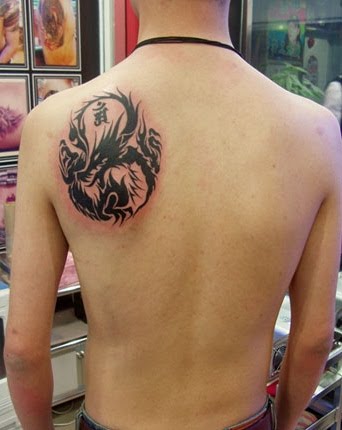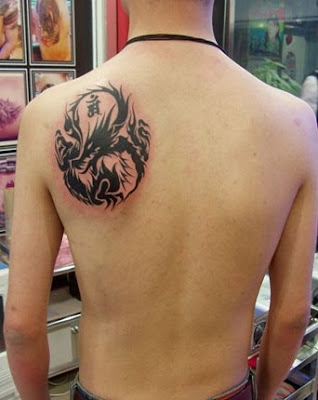
A special shape of free dragon totem.
 Tribal Tattoos, although may appear to be simple at times, are undoubtedly appealing and among the most popular today. This article will help those especially new to the world of tattoos in general and particularly, Tribal Tats. The following walk through history will help shed light on some of the different Tribal Tattoo Ideas used throughout the decades.
The most common Tribal Tats found today dates back to the polynesians who used black, geometric tatau ornaments which appeared to be silhouette-like in many ways. In Europe, sailors were attributed for the earliest Tribal Tat ideas - they originated from Tahiti and were added together with the sailors' own maritime-themed designs. Over the years, they have evolved to become what is known as traditional tattoos.
Over in America, Leo Zulueta and Don Ed Hardy, an innovator, were both responsible for an exciting Tribal Tats boom in 1982 when they started "Tattoo Time", a magazine on tattoos. Featuring native Borneo and Samoan tattoos, it quickly popularized these tattoo ideas as a form of interesting tattoo style and design.
As illustrated from above, these modern day tattoos have strong ties and affiliation with natives and tribes from different parts of the world. It was from there that they slowly evolved into the Tribal Tattoo ideas we have today. Although it has been said that a handful of tattoo parlors and tattoo artists would turn down tribal tattoo designs due to their simplicity, a lot of tattoo enthusiasts begs to differ. Tribal Tats, as a matter of fact, needs articulate skill to be tattooed on the difficult body parts in order for it to look naturally "grown". In addition, it has also been said that the coloring of these tattoos requires a steady hand.
You can find an assortment of tribal tat ideas ranging from tribal armbands, flames, black, crosses, stars, tigers and an assortment of motives and designs that are based on tribal motives. Personally, I have 3 tribal tattoos tattooed on different parts of my hands - one of a tribal flame on my right shoulder, one of a tribal motive which I designed on my left shoulder and another circular tribal design on my right wrist.
 Ritualistic tattoos:
We are living in times where tattoos and body modification are more associated with fashion than related to the original idea of getting your body permanently marked for magic, spiritual or personal reasons.
Actually many believe that the first tattoos were created by accident. The most viable theory that I read was that some tribes used to treat open wounds by rubbing or patching them with some kind of herb or flower elixir, which probably produced some kind of ink. This ink while in touch with the cut created a permanent mark and at the same time due to the phototherapeutic use of it helped the wound to heal.
Even if the original meaning and origin of body modification is mostly lost along the history we know that thousands of years ago it was used in many different ways, mostly deriving from the human believes and creativity.
The little that we know about tattoo and corporal modification history allow us to say that they were sometimes used not only as part of healing or transition rituals. They were also used as identification between tribes, bravery and adulthood signs. Some warriors like the Vikings used to get their faced tattooed to frighten their rivals. Other tribes used to tattoo their female's faces to avoid them from being kidnapped or raped by enemies.
In other barbarian cultures, which became famous for their cruelty, before killing their tattooed prisoners the warriors were given the right to de-flash their prisoners and use the adorned skin as a protection charms. The same procedures interestingly enough were repeated during the WWII, but with non adorned skins. What says tons about development and modern civilization.
At this time tattoos, scarification and insertion of seeds and pits under human skin were well seen around the primitive world. Unfortunately in Persia, due to its non erasable character; Tattoos became a way of marking slaves. This idea somehow pleased the Greeks and the Romans which not only marked their slaves; they also tattooed thieves and outlaws.

The human body is the tool through which somebody experiences life and his surroundings as well as interacts and communicates with others. To some people, however, the body is another piece of canvas through which they could express themselves, their beliefs and their traditions.
Drawing a Picture, Telling a Message
Just as paintings hanging on walls make a room more beautiful, body art can enhance a person's good physical attributes. Some ladies have a sunflower tattooed on their backs so that they can wear backless dresses that will reveal their flawless skin adorned by the tattooed flower. In this sense, body art is worn the way diamond necklaces are - it is meant to adorn and enhance the wearer's beauty. However, there are other much more complex reasons for the proliferation and practice of body art. These reasons can be cultural, political, or spiritual.
Body art is extremely common in jails. Tattooing and branding are some of the most common rites of passage for inmates who wish to be part of certain groups. Body art can also be used to declare personal beliefs and political stand. In this case, body art can be compared to graffiti on the wall; it declares what the person wearing the art believes. People in ethnic groups also used tattooing extensively as a form of ornamentation. In some cases, tattoos were used to mark how many people a warrior has killed in battle.
Body Art Types
Widely known types of body art are body painting, tattoos, shaping, scarification, branding and body piercing. Body painting is usually done by painting on the body, usually covering the whole body completely with water-soluble makeup or paints. Body painting is very similar to painting on canvas, however, it can be more difficult to accomplish as the body has contours that makes painting pictures and scenes on the body more complicated.
Tattoos, probably known by all, are permanent decorations on the body applied through the use of an electrically ran needle. Body tattoos usually cover a relatively small portion of the body. Favorite places for body tattoos are the chest, the upper arms, and the back of the shoulders. Body tattoos are relatively permanent, too, as the picture or the letters are etched onto the skin.
Body piercing is accomplished through the use of materials such as beads and precious stones and metals. Ear piercing is probably the most practiced by women and some men for accessorizing. Today, piercing is performed on almost all parts of the body such as the nose, the lips, the tongue, the eyebrows, the bellybutton, the nipples, and others. Shaping, on the other hand, is done to permanently shape the body according to a person's preference. Methods of this type of body art are foot binding - common among Chinese women.
Scarifications are more unconventional methods of body art. There are religious groups that deliberately scar their body (usually with pointed objects like knives) using a prescribed pattern. Somewhat similar to scarification, branding is another type of body art that involves a whole lot of pain. This was originally done to farm animals (cows and horses) and originally used for identification purposes. This is accomplished through placing an extremely hot piece of metal with a certain design on the body until it burns the skin and leaves a mark that may last forever.
Whatever form of body art is practiced, it is certain to elicit varying reactions. Body art can be beautiful, captivating, or disturbing depending on the beholder's point of view and set of values.